Nancy Templeton in Trouble Again Part 2
For Bonnie and Frodo
Omne trium perfectum
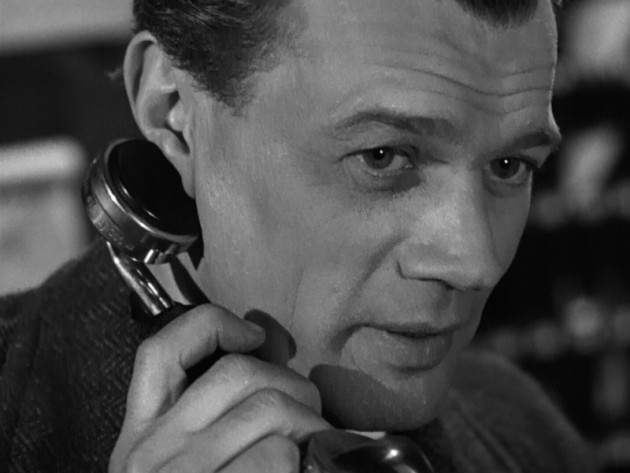
The motion-picture show is chosen The 3rd Man and constantly reinforces the dominion of three in its three-act construction. Greene was undoubtedly aware of the impact of triadic use and the rule of three has a major impact on the progressive effect of the dramatic components. There were three men at Harry'due south supposed decease, as Holly is eventually told. There are 3 characters whose names brainstorm with H: Holly, Harry, Harbin. Baron Kurtz says he has acid, Harry needs antacid tablets from the States, and the kicker is his involvement in the city'due south diluted penicillin noise: in Greene's first draft script he has Calloway describe it as "working like a totalitarian political party." There are three visits to the city's cemetery and Harry'due south funerals bookend the narrative.
Holly
Theme
Lajos Egri formulated the classic approach to dramatic writing in which he states premise – or theme – equally the cardinal component of the successfully written play:
Every adept play must have a well-formulated premise. There may be more than one fashion to phrase the premise, but, however information technology is phrased, the thought must be the same.
He urges the playwright:
You lot must have a premise – a premise which volition lead you unmistakably to the goal your play hopes to attain (Egri, op.cit.: 6).
He also states: "In a well-constructed play or story, information technology is impossible to denote only where premise ends and story or character begins" (29). "Neither the premise nor any other role of a play has a dissever life of its own. All must blend into an harmonious whole" (31). Greene's work is consumed by issues of loyalty, betrayal and treachery: this deep structure underlies the movie. Treachery is signified in each of Harry'southward compadres but besides in the horrifying manchild Hansel with the circular confront who wrongly accuses Holly of being a murderer – he is mayhap an allusion to Harry himself equally he comes to exist revealed in Orson Welles' babyface or indeed a preview of coming attractions in Nicolas Roeg's later Don't Await Now (1973) as Paul Driver points out (1990: 38).
The homo who knew too much
Philip Dunne writes, perhaps rather contentiously, in his memoir,
The director may contribute visual and technical style, only the essential style of any picture is in the delineation of graphic symbol, in the building of disharmonize and drama, in what stimulates the viewer's mind, not his eyes, and that is the contribution of the writer (Dunne, 244). 1
Undivided authorship is a rarity; the model for a truer agreement of filmmaking praxis is more than likely to reside in models of multiple authorship. The value of auteurism in its original incarnation lay in its recognising of certain directors' contributions to films; and in the elevating of Hollywood genres (Tudor, 1973: 122-3). Its essentialism equally an interpretive text however denies its wider applicability: theory cannot prescribe exercise, only describe it postal service hoc; and auteurism, every bit Dudley Andrew points out, may be experiencing a renaissance (Andrew in Stam and Miller, 2000: twenty-30). Auteurist study retains its intrinsic value and relevance if information technology is applied to a wider variety of picture palace practitioners, redressing the residue of film history through a more precise attribution of authorship and the evaluation of other cinematic signatures through the detailed exam of, equally, for example, in this case, a unmarried writer. Its great achievement was the evaluation of American movie house, still the world's ascendant narrative force. As Robin Wood points out, the search for a construction "can describe attention to some of the possible sources of a successful work's vitality" (Wood, 2006: 248). By exploring "the thematic and formal relationships betwixt ostensibly different projects of a single" [screenwriter], a consequent pattern can be observed which suggests a personal vision or controlling idea, the constituent elements denoting a cinematic writer. By addressing the visual aspects of these same screenplays the project of auteurism is extended into a formal discourse which extends its relevance to picture show studies (Luhr and Lehman, 1977: 26). Wood besides declares: "A work of art can transcend the personality, values, world-view of the creative person; the greatness of a given moving picture may be the product of an intricate interaction in which collaborators, circumstances of production, studio pressures, might all play their role (Forest: 248).
Every bit Pam Melt avers, the concept of the auteur in British movie theatre has been immensely problematised past the specificity and space rearrangements pertaining to British flick culture involving bug of critical gustation, concepts of literary value and criteria attaching to value, all stressed and invigorated by debates within the journals Sequence, Sight & Sound and Picture show (Cook, 1990: 147). Ballad Reed'southward career happened to precede the debate and endure during the 1940s and onwards while it was at its zenith, through the 1960s when his reputation proceeded to decline. Melt states:
Reed's reputation equally a distinguished metteur-en-scène seems to rest on the prove of a few films from his total production and a few privileged moments in some films which tin can be seen to epitomise the 'essence' of his way: the business organisation with employing cinematic mise en scène to emphasise social and psychological conflict (Cook: 158).
In the late 1940s James Stonemason was considering a move to Hollywood; he thought that a fluke hit like The Seventh Veil (Bennett,1945) was rare. At that fourth dimension in British cinema he says that equally there were just half dozen skilful directors, including Reed, and if each of them fabricated a motion picture, "that would be a very practiced yr" (Mason, 1982: 206). In his memoir he states that Reed was his favourite managing director: "I had never worked with him only in every one of his films that I had seen there was great warmth and understanding… I had admired Carol Reed only from a distance. Though he was the director with whom of all directors in the world I was most keen to work" (Stonemason: 213-4).
Expressionist heritage
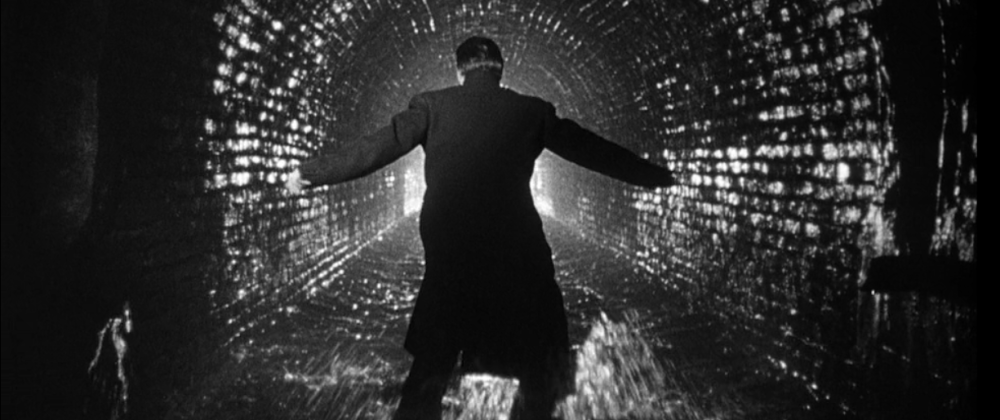
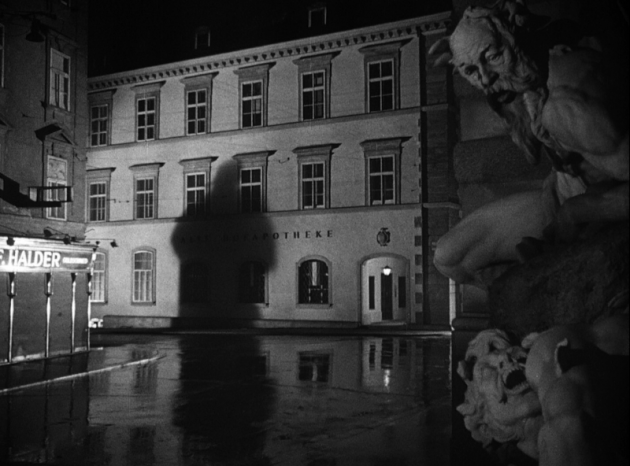
According to his biographer, Reed believed himself to be the translator of authors' stories. Cook argues that these collaborators contributed more to Reed'southward position than his own piece of work (Ibid.). And Drazin states: "for Reed the story was paramount. He could plumb the deepest depths of grapheme, squeeze out every last drop of atmosphere and tension, but always he did so in service of the story" (Drazin, 2000: 85). Yet, equally Nicholas Wapshott points out, "inevitably elements of Reed's character do surface in his films, for he was non able to purge his own indicate of view entirely from his piece of work, even though he had go used to disguising who he was for most of his life. The glimpses of Reed in his films are to be found among the many children who wander helpless and innocent through an adult's world, and in the amoral heroes who suit themselves whatever distress they may cause to others" (Wapshott, 1990: 343). I obvious indicator is the straight quote from his previous film, The Daughter in the News (1940) when a cat watches his mistress overdosing – something that would exist finer repeated in The Tertiary Man. He quotes other films, too: Joseph Cotten's archway to Vienna on a train wreathed in smoke replays his arrival as murderous Uncle Charlie in Hitchcock's Shadow of a Doubt (1943), itself a nod possibly to Tolstoy; while his emergence from a shrouded tunnel after killing Harry provides not just closure on Holly's quest for truth and vengeance but parlays a visual rhyme with the opening shot. The overall visual manner, in item the tilted shots, reflects the Expressionist choices he made for filming _Odd Man Out _ (1946), also DP'd by Robert Krasker, in another example of a moving-picture show concerned with moral equivocation in a metropolis nether occupation. James Mason observed of him that he "had the virtue of absolute unpretentiousness. He was unaffected past technical gimmickry… Other directors fall in love with their zoom lenses, extravagances of cut or the dubious virtues of the hand-held photographic camera. Carol Reed favoured a steady camera so that the spectator would be totally unaware both of camera move and of cutting" (Mason: 217).
Dan O'Herlihy spoke to author Sheridan Morley:
… it was really Carol's film: he knew exactly what he wanted each frame to look like and, autonomously from Robert Newton as the painter and Fay Compton as the woman who takes Bricklayer into her home, he cast the whole picture locally in Belfast so it has this remarkable authenticity (Morley: 79-80).
Charles Drazin believes it is in that production that Reed "found his register. He found the things he could exercise well – an empathy with children, a feel for urban space, a sense of the unexpected" (Drazin, 2007: 66). He finds that Reed's talent for orchestrating chance stood to the film, including casting extras off the street, filming on actual bomb sites and permitting Welles to improvise the famous cuckoo clock speech which is likely adapted from McNeill Whistler (68). The author concludes that "the luminescence of his all-time work lay not in putting forward a bespeak of view, merely in an intuitive feeling for the style people are and what they do. He was an observer." He likens the director to an Onetime Master: "their art lay not in what they chose to paint simply how" (seventy).
The strategic decision to film The Third Human primarily on location (one of the first British films to practice and so) lent itself to the neo-realistic manner to which Reed was becoming aligned and placed it in a spectrum of politically-oriented films set up in the occupied cities during the menstruum in question (1945-1955). The abstraction of the zither's strings in closeup in the title sequence hints at an avant garde inclination on the part of Reed but it also provides a template for the visuals' focus on the city as a series of parallel lines which eventually cross metaphorically at various intersections, moral and storywise (Misek, 2007). The impossibility of the characters' lives intersecting successfully is also wrought in this hit opening image. The acute off-centre angles utilised past Krasker accentuate Holly's lack of knowledge and agency also as agonizing our perception of what it is nosotros recall we are seeing. The complex visual design and shooting style obviates any prior knowledge of the city; the jump-cutting confuses our notion of space and perception and enhances our empathy with Harry's situation as he is ultimately trapped by the motion-picture show's aesthetics. The moral social club is ultimately restored, if temporarily, but with Harry'south death the price. Self-righteousness trumps loyalty. Ray Durgnat sums up the authorship of the moving picture every bit follows: "Greene and Reed share 1 inspiring obsession: treachery – malevolent, or righteous, or inadvertent – is the human condition" (Durgnat in White potato, ed., 2008 : 257). Overall, it could be stated that Reed'due south complex relationship with contemporary film aesthetics is directly expressed in his choices for The 3rd Man. Paul Driver lists his props starting with the parrot, and so the "brawl, balloons, bunches of flowers, dog, cat, teddy bear and the numerous staircases" (Driver, 1989-90: 38).
Animals connote activeness too. Ever the primary of concealment, Harry's whereabouts are given away by the presence of a lovable kitten ("I just liked the idea of a cat loving a villain – the amuse of the man!" declared Reed, quoted in Wapshott: 229); the miniature domestic dog tells Holly that Kurtz is dining with Dr Winkel; while the analogy of Harry with a rat is the last indignity prior to his killing in his chosen escape route, the sewage arrangement. This is like to He Walked Past Night (Werker/Isle of mann, 1948) in which a psychotic murderer uses his cognition of Los Angeles' system to escape the police, until the last confrontation; and similarly gave a gifted Director of Photography (in this instance, John Alton) ample opportunity to visually exploit the possibilities of chiaroscuro light and shade, deep focus, wide lenses and an overwhelming sense of entrapment. In even so some other symmetrical incident and paradigm which accretes the complexity of the moving picture's construction, the spiral staircase on which Harry is finally caught mirrors the flat firm stairwell, just now his fingers grasp pointlessly onto a Viennese square through a grating – there is no escape. And the air current whistles as though tumbleweed were about to blow through a western town, with voices echoing in the altitude.
Sarris pinpoints Reed'south characteristic banner in movie house: "Reed's films are distinguished by the subtlety and diverseness of his directorial devices, and the integration and balance of those effects within a controlled frame. Reed is unique without existence completely original or revolutionary. His genius is relative rather than absolute, relational rather than specific. Other directors are subtle and varied, also, but at this point in his career, Reed is more and then" (Sarris, Oct 1957: 12). As Nicholas Wapshott points out, "information technology was Reed's close involvement in all aspects of his films, from scriptwriting to set design, cut and editing, which had acquired him to hesitate about working in Hollywood" (Wapshott, 1990: 180). But the picture show would be a triumph despite the meddling past Selznick and the diva-like behaviour of Welles, who was nether contract to Korda for three films.
Naming names
The naming of names is of paramount importance in The Tertiary Man. Harry Lime connotes both Philby and Greene himself (his given name was Henry Graham), while Harry'due south story has equally we take seen many of the contours of Philby's life in 1930s Vienna, including the circumstances of his marriage to a Communist in 1934; Holly patently references the author and his movement betwixt fact and fabulism, in a modify to the treatment where the character is called Rollo. Calloway is a letter of the alphabet abroad from his real-life inspiration, Galloway, with all the dread that those first two syllables supply (in both cases); Anna is a slippery anagram that could be of any national origin yet calls to mind several heroines in Greene's fiction; and Sergeant Paine'south destiny is writ large in his surname. Holly's constant mispronouncing of people's given names betrays his discomfort at his own 'airheaded' name, which he admits belatedly in the narrative; while Anna's repeated use of 'Harry' for 'Holly' suggests that he will in fact supplant Harry Lime in her life, as Holly hopes, simply it is not to be. She cannot tolerate his disloyalty to his childhood friend. Holly despises policemen and calls them only 'sheriffs.' He deliberately mispronounces Winkel'due south name and repeatedly calls Calloway 'Callaghan.' The naming of things and people is crucial to our agreement of Vienna, the biggest character of all, a liminal space of bridges and slippery cobbled streets, locked off above and filled with traps beneath. Language is futile and the altitude between people is directly expressed in their particular brand of logophobia. Words are simply inadequate to clear the postal service-state of war condition.
A quest
Former Hollywood creative advisor Chris Vogler's Hero's Journeying model equally interpreted in The Writer's Journey proved a popular text in the 1990s, non least among Hollywood'south development executives, simply as well among film and screenwriting students. It provides an accessible reading of Joseph Campbell'south take on Carl Jung through straight application to screenplay analysis. Providing a paradigmatic model for the practising screenwriter, Vogler discusses the major elements of Campbell'southward The Hero With a Thousand Faces in terms of mainstream Hollywood cinema. The twelve-point template Vogler proposes is as follows and maps onto traditional dramatic structure thus:
Human action 1:
1. The hero lives in the Ordinary World (Holly is a broke writer)
2. The hero receives a Phone call to Adventure (Harry invited Holly to visit)
three. The hero Refuses the Phone call (Holly arrives besides late)
iv. The hero Meets his Mentor (Holly attends Harry's supposed funeral)
5. The hero Crosses the Threshold,
Act 2:
6. and encounters Tests, Allies and Enemies.(Holly meets Harry's friends)
vii. He approaches the Inmost Cave, (Holly finds Harry alive)
8. where he endures the Supreme Ordeal. (Holly learns Harry isn't straight)
9. The hero Seizes the Sword. (Holly defends Harry)
Act Three:
ten. and journeys on the Road Back (Holly is finally persuaded of Harry'due south sick-doings)
11. The hero experiences Resurrection (Holly delays his trip dwelling house and kills Harry)
12. and Returns with the Elixir (Holly is alive but fails to get Harry's girl)
(Vogler, 1992: 236)
The classical structure of The Third Homo maps, with a couple of twists, onto the format. Howard and Mabley remind us that "the protagonist and the obstacles he or she encounters must be fairly evenly matched… This point may be contradicted by such films equally The Third Man … in which the chemical element of a past action poses overwhelming odds against the accomplishment of the objective. It should be noted that the protagonists practice no acknowledge the inevitability of failure until that failure stares them in the confront and they must bow to it. They fight against the odds, believing they have a hazard of succeeding; it is the character'south belief that keeps the story alive, that gives us the needed shred of hope that the goal might notwithstanding exist achieved" (Howard and Mabley, 48). Vogler'south impetus to write the volume came from his experiences as a creative analyst at a major studio – Disney– when he decided to collate the lessons he had learned from world storytelling into a model for agreement screenplays. A memo to this upshot, outlining his findings nearly the shape of popular stories, circulated in Hollywood and eventually mutated into the published volume. By the time this had occurred, his tenure at Disney saw the studio return to summit form with unprecedented box office grosses by creating traditionally structured fare —forth the lines suggested past Vogler— such equally The Niggling Mermaid and The Lion Rex. This structure tin can be easily mapped onto The Tertiary Human being, as above, and increasingly, global, pic narratives – and not merely because Vogler is a regular on the global script lecturing circuit, frequently employed past state-sponsored media bodies. ii This structure hands tells united states of america Holly's role in the narrative if not quite grasping the complexity of the friendship that underlies it.
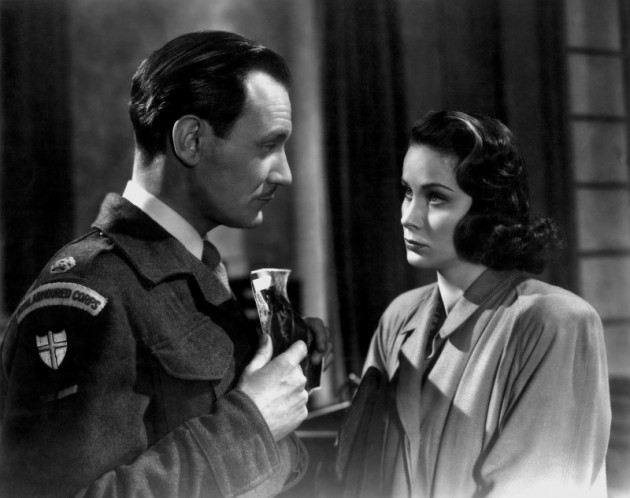
Calloway and Anna
Holly finds himself running after Harry's shadow – and it promptly disappears from sight. He is alone in an empty square. He brings Calloway and Paine and they are momentarily puzzled – until Calloway reveals that the kiosk has a door and the stairwell leads into the city'south main sewer and onto the Danube. "We should have dug deeper than a grave," he muses. And so they go to the cemetery a second time and open up the coffin that was laid in Harry'southward name and discover the corpse of Harbin. "Next time nosotros'll accept a foolproof coffin," promises Calloway. Back at Anna's apartment four military constabulary arrive in a jeep to take her away because of 'protocol.' "I don't even know what that means," confesses the British member of the party. Holly rushes to her and cries out, "I've but seen a dead human being walk. Now I've seen him live." Calloway asks her when she final saw Harry and she swears it was ii weeks ago. He tells her about Harbin. "Vienna is a closed city, Ms Schmidt. He can't go away." "Poor Harry," she says, "I wish he was expressionless. He would be safe from all of you and so." In daylight, Holly visits Kurtz and Winkel, the backdrop to the flat in the Russian sector is piles of rubble – and, crucially, the Prater Wheel, miraculously spared from bombing. He demands a coming together with Harry and waits by the bicycle. "Or do ghosts only ride by night, Dr Winkel? Got an opinion on that?"
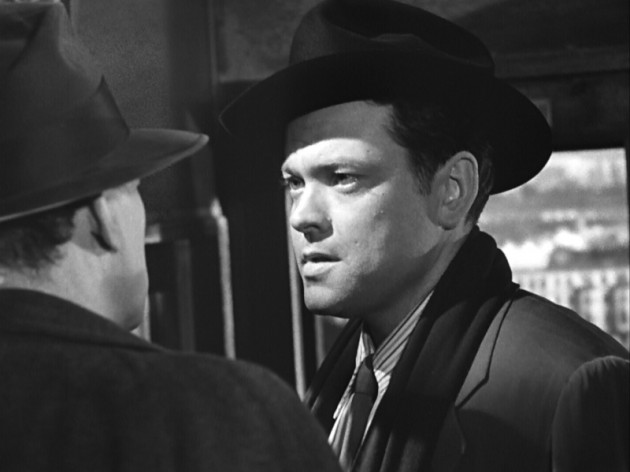
Located deep in the Russian sector, it is the perfect spot for Harry to reappear and create more than mystery. Harry approaches Holly in a long shot, like a western character approaching a shootout. Holly admits telling the police. Harry doesn't care about Anna's predicament and Holly works out that it was he who handed her over. Holly tells him they opened his grave. Harry opens the door to the railroad vehicle and they have a conversation with unsaid threats of killing Holly. "The world doesn't brand heroes," Harry tells Holly, "outside of your stories." "You lot used to believe in God," sighs Holly. Harry's inflated opinion of himself aligns him with political leaders gazing downwards at the dots below the Prater Bicycle with infinite contempt. They are not people to him.
He complains about the antacid tablets he needs from the States for his digestion and delivers his famous cuckoo clock speech, rushing off past the carousel. He has spent precisely five minutes stating his point of view.
Calloway instructs Holly to accommodate to meet Harry in a café where he volition exist lifted. "Twenty years is a long time," pleads Holly, "don't ask me to necktie the rope." He sees Anna's passport and cuts a deal for her release. At the railway station as Paine loads her baggage and she looks out of the railway carriage she espies Holly entering the café. She suspects he is meeting Harry and remains with him, mis-naming him 'Harry' once again. "Poor Harry," she then says, nearly the existent Harry, when she realises he is nearly to be caught. "You lot've got your precious honesty and don't desire anything else," she chides Holly."… I don't want to see him, hear him," she says when Holly realises she still wants Harry. "But he's withal function of me, that's a fact, I couldn't do a thing to damage him." The train whistles. It's a warning. "Look at yourself," she tells him. "They have a proper noun for faces like that." Harry shows up and it looks as though he might kill Holly with his handgun but Anna warns him to run.
I think we are in rats' alley where the dead men lost their bones
And then the descent into the underworld. Greene describes this in the novella:
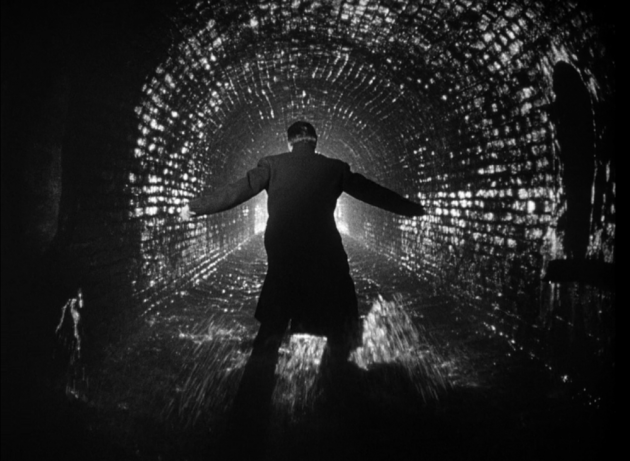
Lime trapped like a rat
What a strange world unknown to most of u.s.a. lies under our anxiety: we alive above a cavernous country of waterfalls and rushing rivers, where tides ebb and menses as in the world above. If you take ever read the adventures of Allan Quatermain and the account of his voyage along the underground river to the city of Milosis, you will be able to picture the scene of Lime'due south last stand. The main sewer, one-half as wide as the Thames, rushes by under a huge arch, fed by tributary streams: these streams have fallen in waterfalls from higher levels and have been purified in their fall, so that simply in these side channels is the air foul. The master stream smells sweetness and fresh with a faint tang of ozone, and everywhere in the darkness is the audio of falling and rushing water (Greene, 1950: 314).
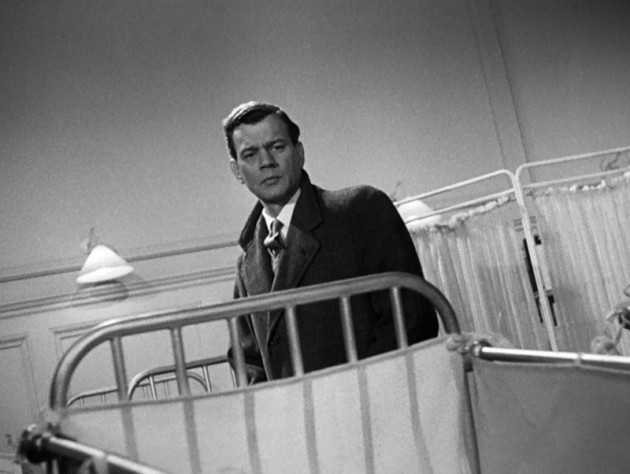
The film's dénouement hinges on Holly'due south conclusion – to stay or to become. In the end, en route to the drome, Major Calloway stops at the Children'southward Hospital where Holly is shown the devastating effects of the diluted penicillin. Nosotros judge the obscenity of the ersatz medication by his facial reactions. I kid'south expiry is signalled by the upturning of their Teddy bear. Holly stays – he knows he is the lure for Harry's decease. He takes activeness, goaded into to information technology past Galloway'southward fatal bargain. Their pas de deux exploits Calloway's recognition of Holly's chapters for jeopardy and betrayal. This is the dramatically logical outcome to Holly'due south visit to Vienna and the outcome of his quest. He is the only person who can impale Harry, who is now his nemesis when his sense of justice is outraged at Calloway's heavy-handed proffer and he knows Harry has sold out Anna. In order to achieve this, he has to overcome his own distaste for playing at sheriff. This is the point of no render in the narrative. Paine has loaned his copy of The Oklahoma Kid to Calloway, therefore the action is spun into another phase. Holly is sheriff.
The exciting chase sequence commencing in the rubble where Harry has been watching his watchers and proceeding along the streets where he is pursued by troops and the audio of sirens hush-hush into the sewer, is masterfully staged and executed. Due to interference by censors a line had to be added to Calloway's dialogue giving Holly permission to shoot. When a figure emerges, wreathed in smoke at the end of the tunnel, we are unsure who has survived the encounter. The film cuts to a funeral, where Holly over again stands beside Calloway and we know this is perfectly symmetrically constructed, with the really Harry Lime finally put in a grave. Holly has ratted on his friend, in this tale of always-changing parallels and symmetries. Anna throws dirt on the coffin – which she did not practice at the fake funeral, suggesting mayhap she ever knew Harry was still live. Then she walks away, every bit before. Nonetheless Holly alters his behaviour this time and asks to exist let out of the jeep to talk to her but she walks by him. The construction of the film is therefore a symmetry that does not merge with convergent destinies: Anna'southward rebuffing of Holly demonstrates that the past is just that, and does non mean there is an alternate futurity. She refuses pity or a grade of colonising and presumably carries on with interim, her profession. She has been acting all along, after all. Equally Charles Drazin points out, it was Selznick's suggestion to accept this exist the film'southward ending. Greene's happy ever later merely did not ring true (Drazin,1999: 23). Holly's try to rewrite Anna's life as he has done his ain (and Harry's) has but brought tragedy to her door. His redemption has come up through the employ of controlled violence. Information technology has overcome his friendship. The creator of hack fiction has go the destroyer of a real man. The sediment of passion which underlies his actions is not reciprocated.
Co-ordinate to Carpenter, Greene never dislocated personality with morality (Carpenter, 1987: 63) therefore the issue of Holly'south loyalty to Harry does not transgress the theme of the story. Harry is so charismatic that he overwhelms Holly and equally Joseph McBride states, "the lasting appeal of dark, complex characters, whether they are villains or antiheroes or deeply troubled heroes, demonstrates that the virtue of 'likability' is largely confined to real life, not dramatic storytelling" (McBride, 2012: 49). "One tin't just get out," protests Calloway to Holly, half-heartedly as they exit the cemetery post-obit the 2d, existent funeral for Harry Lime. "Be sensible." "Haven't got a sensible name, Calloway," says Holly. Calloway watches as Anna walks by him.
A grave literary enquiry
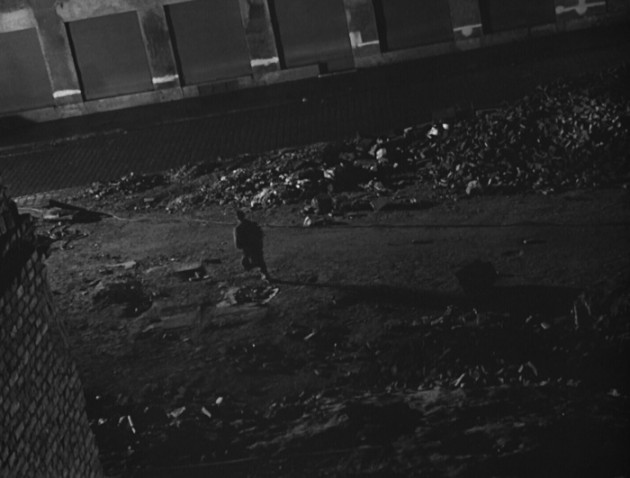
The Chase
The dissolution of order leaves us bereft. The arc of the story is not contradistinct but information technology is dramatically logical and unfolds with a shootout as the generic impetus suggested by Holly'due south novels always directed us to expect. Holly's quest for truth has become 1 of vengeance, similar the typical western hero of his pulp novels. No longer an outside observer just a participant whose determination to act leaves devastating consequences only as well a supposed restorative justice, nosotros are left to ponder in a Thomsonian fashion what kind of books Holly might effort in the aftermath of human tragedy. No longer a neutral, loyal friend or hapless drunken tourist, he has become what he most reviled. His westerns might have obtained the kind of psychological component developed afterwards World State of war 2 in their cinematic iteration, in which a more cautionary attitude to violence and venality coloured the depiction of gunslinging, territorial acquisition and conquest and the genre became mature and self-questioning. The Third Homo is balanced precariously betwixt opposing lines of thinking, border controls and symmetries, in a system of binary structural oppositions that culminates in the restitution of gild after the anarchy of 1 man's playing the post-war organization in an occupied city filled with little fiefdoms battling for control. The ending was inverse from Greene's novella, and he stated that it was amend because the original, in Reed's view, would have been as well contemptuous. Freighted with history, Anna takes a long walk toward and by the camera in bleached daylight, leaving the ever-hapless Holly in her wake. The film's last shot, achieved with some practical difficulties on the twenty-four hour period, peels away the pretence of friendship or goodness or decency. Anna's integrity is intact. Holly is bereft: a traitor and a killer, he has not managed to steal Harry'due south lover or modify the world or do annihilation worth mentioning. He just killed his best friend —even if it were to be interpreted as a mercy killing and on armed services orders. He chased Harry'south shadow and discovered his ain. The desolation is wrenching.
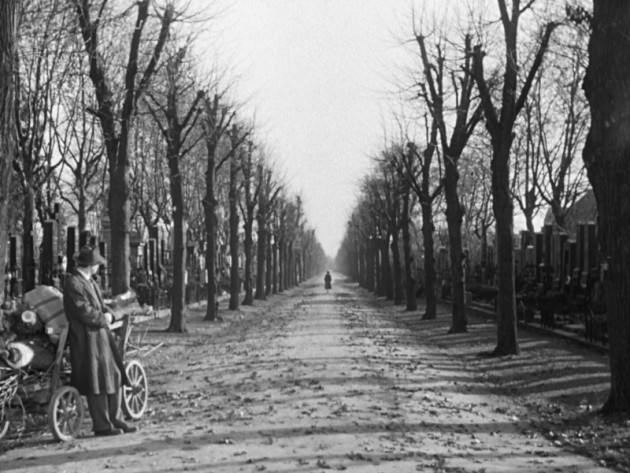
Final Scene….what a shot
A moral vision
Principal photography was completed 31 March 1949 and the film was released in the United Kingdom 03 September 1949 and 06 January 1950 in the United states. There was a slight difference in the text of the opening voiceovers (and while the American release was voiced by Joseph Cotten, the British 1 was performed by Reed). It was a huge success and Anton Karas' theme music was a striking. The film won the Grand Prix at Cannes and Robert Krasker received the Academy Award for best black and white cinematography (Reed was nominated for directing and Oswald Hafenrichter for editing). Information technology won the BAFTA for Best British Picture and the National Board of Review award for Best Strange Film. Information technology would remain a huge audition and critical favourite equally the lists of Best British Films attest over the intervening years. 3
Robin Wood points out that the search for a structure "tin can describe attending to some of the possible sources of a successful work's vitality" (Wood, 2006: 248). Past exploring "the thematic and formal relationships between ostensibly different projects of a single" [screenwriter], a consistent blueprint can be observed which suggests a personal vision or controlling idea, the constituent elements denoting a cinematic author. Past addressing the visual aspects of these same screenplays the project of auteurism is extended into a formal discourse which extends its relevance to film studies (Luhr and Lehman, 1977: 26). Greene's earth of subterfuge and conflicting loyalties was counterbalanced by Reed's humanity in this interpellation of retentiveness, history and genre. Brian MacFarlane describes the pairing of director and writer: "Reed'due south and Greene's creative personalities chimed perfectly in their two 40s films: both films are studies in disillusionment and the melancholy of innocence brought face to face with abuse" (MacFarlane in Barr, 1986: 133). Whatever local objections existed to the production and its release, as Thomson argues, "a time and a identify were captured; scenario and locale were stirred, like cream going into nighttime coffee" (Thomson, 1994: 621-two).
In fiction, he is tart but refreshing. Whereas, in life, he was toxicant (Thomson, 1985: 102).
For a protagonist'southward plight to exist fully communicated it is essential that he have a worthy antagonist. Harry Lime is all that, living on in the imagination long after Holly Martins' delusional treachery is forgotten. In this pic, Greene found a manner to transmogrify fact into fiction, with a heart, a soul and a conscience. Reed consolidated the internal dilemmas with wonderfully significant external reality. Greene was grateful to Reed and wrote of him that he was " 'the simply director I know with that detail warmth of human sympathy, the extraordinary feeling for the right face for the right office, the exactitude of cutting, and not least important the ability of sympathizing with the author's worries and an ability to guide him'" (Drazin, 2007: 68). Harry Lime would have an afterlife, in a radio series produced by Harry Alan Towers that was designed as a prequel to the picture and was played (and to an extent written) once more by Welles, simply, equally Matthew Killmeier puts it, sweetened for the internationally syndicated domestic palate (Killmeier: i). It commenced with a gunshot and a voiceover by Harry himself explaining his resurrection from the sewer, no longer a victim of an aesthetic based on entrapment. It gave rise to the feature movie Mr. Arkadin (besides known every bit Confidential Study) (Welles,1955) which was adapted from the 37th episode, 'Man of Mystery', with a Citizen Kane-type screenplay by Welles. Critic Jonathan Rosenbaum has identified seven different versions of the picture show, complicating further Welles' contribution to the authorship of the character Harry Lime (Rosenbaum, 2007: 146-162). In David Thomson's universe of Suspects, Lime is resurrected every bit a magazine graphic symbol and Tv star past Martins in order for him to prolong his ain career equally fiction-maker. In fact there actually was a Tertiary Man TV prove, which ran for five seasons, starting in 1959 and it was based on stories published in The News of the Globe.
Thomson imagines Holly to accept been Harry'south 'pet crony' and the Juliet to his Romeo, in Dulwich College, alma mater of Raymond Chandler, whose pb he follows in this hallucination of noir. Harry's career besides mirrors Philby's in his forming the International Refugee Part which grants him a cover for his rackets. So his legend lives on, as that of a notoriously sympathetic villain, in our collective psyche. Holly is just a user and the most demonic of bad friends. As T.S. Eliot once wrote, "Humankind cannot bear very much reality."
He had all the small loyalties to his colleagues, and of grade his big loyalty was unknown to us (Greene in Philby, 1979: 9).
For Greene, friendship trumped everything and he remained loyal to Philby even after he was named as the third human by the newspapers following his beingness cleared by Harold MacMillan and his subsequent defection to the Soviet Matrimony. Suspicions near Greene'south supposedly dubious political sympathies followed him to the grave.
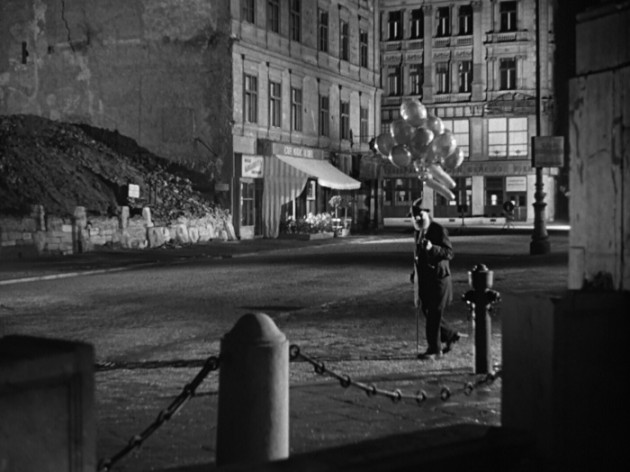
Homage to Lang's M?
Reed and Greene brought out the best in each other and their iii films remained some of Reed's greatest achievements against the properties of a permanently faltering British film industry. "It is true that Carol Reed never fabricated some other film that matched upward to Odd Man Out or The Fallen Idol or The Third Man. Only the fact that they had been made was plenty. They came virtually in an extraordinary decade through a conjunction of circumstances that could not be repeated, and it was in Reed's nature to want to movement on" (Drazin, 2007: 69). Together they crafted a story about storytelling, a plausible fiction and a pleasurable slice of propaganda. Perhaps it is ultimately Reed's moving picture: he changed the ending, his visuals impute the spy genre with the motifs and concerns of the Trümmerfilm and it was his narrative preoccupations that aped an earlier flick The Mask of Dimitrios (Negulesco, 1944), adjusted by Frank Gruber from the eponymous Eric Ambler novel.
The film however plays in Vienna at the Burg-Kino a few times a calendar week. The rich resonance of its tapestry lies in its origins in the vagaries of writing and rewriting, truth and fiction, roleplaying and operation. Finally, myth is counterbalanced by countermyth, the hero gains a motive and becomes a villain, the beast he most reviles –the newest sheriff in town, in a boondocks of as well many such creatures playing loyal to too many paymasters with conflicting agendas. The bigger villain, Lime, is i of the virtually likable men we have ever encountered. The Third Man is ultimately a grave literary inquiry into our behaviour: it poses and answers the question every bit to why nosotros tell stories to ourselves – to brand sense of things, to make things meliorate, to reconcile inertia with action in the face of supposed evil, to have our loyalties tested, to alter the world, fiddling by picayune. The rest is meaningless.
End of Part 2
Part i
(Essay submitted in 2013)
Cheers to Dr Claus Tieber at the University of Wien and to staff at the British and Irish Film Institutes for assistance in sourcing materials.
Bibliography
Books
Aristotle (1920). On the Art of Poetry. Oxford: Oxford Academy Press.
Barr, Charles (ed.) (1986). All Our Yesterdays: 90 Years of British Movie theatre. London: BFI.
Bazin, André (1978). Orson Welles: A Disquisitional View. London: Elm Tree Books.
Behlmer, Rudy (1972). A Memo From David O. Selznick. New York: Viking.
Bogdanovich, Peter (1998). This Is Orson Welles. New York: Da Capo.
Bordwell, David, Janet Staiger and Kristin Thompson (1994). The Classical Hollywood Cinema: Film Style and Mode of Production to 1960. London: Routledge.
Cook, Pam (1990). The Cinema Volume. London: BFI.
Copjec, Joan (ed.) (1993). Shades of Noir. London: Verso.
Drazin, Charles (2000). In Search of The 3rd Man. London: Methuen.
________ (2007). The Finest Years: British Cinema of the 1940s (Cinema and Social club). London: I.B. Tauris.
Dunne, Philip (1992). Accept 2: A Life in Movies and Politics. New York: Limelight Editions.
Dyer, Richard (1998). Stars. London: BFI.
Egri, Lajos (1946; rpt.,1960) The Art of Dramatic Writing: Its Basis in the Creative Interpretation of Homo Motives. New York: Touchstone Books.
Enzensberger, Hans Magnus (ed.) (1990). Europa in Ruinen: Augenzeugenberichte aus den Jahren 1944-48. Frankfurt am Main: Eichhorn
Fay, Jennifer and Justus Nieland (2010). Pic Noir: Difficult-Boiled Modernity and the Cultures of Globalization. London and New York: Routledge.
Glancy, H. Mark (1999). When Hollywood Loved Uk: The Hollywood British Pic 1939-1945. Manchester: University Press.
Greene, Graham (1939/2001). The Confidential Agent: An Entertainment. London: Vintage Classics.
________ (1943/2001). The Ministry of Fear: An Entertainment.. London: Vintage Classics.
________ (1932 /2004). Stamboul Railroad train. London: Vintage Classics.
________ (1950/1993). The Third Man in Brighton Rock. The Tertiary Man. The Ability and the Celebrity. The Heart of the Matter. third reprint. London/New York: BCA.
Higham, Charles (1994). Merchant of Dreams: Louis B. Mayer, MGM and the Secret Hollywood. London: Pan Books.
Hoare, John (2000). The Third Man. London: York Press.
Horton, Andrew (ed.) (2004). Screenwriting for a Global Market: Selling Your Scripts from Hollywood to Hong Kong. Berkeley and Los Angeles: Academy of California Press.
Howard, David (2004). How To Build a Great Screenplay. A Master Class in Storytelling for Film. New York: St Martin'south Press.
________ and Edward Mabley (1993). The Tools of Screenwriting: A Writer's Guide to the Craft and Elements of a Screenplay. New York: St Martin'southward Griffin.
Kemp, Philip and Sir Christopher Frayling (2011). Movie theater: The Whole Story. London: Thames & Hudson.
Langford, Barry (2005). Motion-picture show Genre: Hollywood and Across. Edinburgh: Edinburgh University Press.
Korda, Michael (1980). Charmed Lives. Harmonsworth: Penguin Books.
Lawson, John Howard (1949). Theory and Technique of Playwriting and Screenwriting. New York: Putnam.
Lopate, Philip, ed. (2006). American Movie Critics: An Anthology From The Silents Until Now. New York: Library of America.
Luhr, William and Peter Lehman (1977). Authorship and Narrative in the Cinema: Issues in Contemporary Aesthetics and Criticism. New York: GP Putnam's Sons.
McBride, Joseph (1972). Orson Welles. New York: Viking.
________ (2012). Writing in Pictures: Screenwriting Made (By and large) Painless. New York: Vintage Books.
Mason, James (1982). Before I Forget. London: Sphere Books.
Morley, Sheridan (1990). James Mason: Odd Man Out. London: Coronet Books.
Spud, Robert (ed.) (2001). The British Cinema Book 2nd edition. London: BFI.
________ (ed.) (2009). The British Movie house Book 3rd edition. London: BFI/Palgrave Macmillan.
Nowell-Smith, Geoffrey et al. (1996). The Companion to Italian Cinema. London: British Movie Found.
Palmer, Linda (1998). How To Write Information technology, How To Sell Information technology: Everything a Screenwriter Needs to Know Near Hollywood. New York: St Martin's Griffin.
Philby, Kim (1979). My Silent War: The Autobiography of Kim Philby. London: Granada Publishing.
Richards, Jeffrey (1997). Films and British National Identity: From Dickens to Dad's Ground forces (Studies in British Popular Culture). Manchester: Manchester University Press.
Ricoeur, Paul (1990). Fourth dimension and Narrative Volume 1. Chicago: University of Chicago Press.
________ and David Pellauer (1995). Figuring the Sacred: Organized religion, Narrative and the Imagination. Minneapolis: Augsburg Fortress.
Rosenbaum, Jonathan (2007). Discovering Orson Welles. Berkeley and Los Angeles: University of California Printing.
Russell Taylor, John (ed.) (1980). The Pleasance Dome: Graham Greene, The Nerveless Motion picture Criticism 1935-40. Oxford: Oxford University Press.
Seger, Linda (1992). The Art of Adaptation: Turning Fact and Fiction into Moving picture. How to Transform Novels, Plays, and True-Life Stories into Screenplays. New York: Owl Books
Shaw, Tony (2006). British Movie theatre and the Cold War: The State, Propaganda and Consensus (Cinema and Society.). London: I.B. Tauris.
Stam, Robert and Toby Miller (eds.) (2000). Film and Theory: An Album. Oxford: Blackwell Publishers.
Street, Sarah (1997). British National Cinema. London: Routledge.
Swann, Paul (1987). The Hollywood Characteristic Film in Mail service-War Britain. London: Croom Helm.
Taylor, John Russell (ed.) (1980). The Pleasure Dome: Graham Greene, The Nerveless Film Criticism 1935-twoscore. Oxford: Oxford University Press.
Thomson, David (1985). Suspects. London: Picador.
________ (1994). A Biographical Lexicon of Film. London: Secker & Warburg.
Tierno, Michael (2002). Aristotle's Poetics for Screenwriters. New York: Hyperion Books.
Timmermann, Brigitte and Frederick Baker (2002/2005). Der Dritte Isle of man: Auf den Spuren eines Filmklassikers/The Tertiary Human's Vienna. Vienna: Czernin Verlag/London: Shippen Stone Publishing.
Tudor, Andrew (1973). Theories of Movie. London: Secker & Warburg.
Vincendeau, Ginette (1998). Pepé Le Moko. London: British Film Institute, 1998.
Vocelka, Karl (1985). Trümmerjahre Wien 1945-1949. Vienna: Jugend und Volk.
Vogler, Chris (1992). The Writer's Journey: Mythic Structure for Storytellers & Screenwriters. Los Angeles: Michael Wiese Productions.
Wagnleitner, Reinhold (1994). Coca-Colonization and the Cold War: The Cultural Mission of the Usa in Austria subsequently the 2nd World War. Chapel Hill & London.
Wapshott, Nicholas (1990). The Man Between: Biography of Carol Reed. London: Chatto & Windus.
Welles, Orson and Others (1952). The Lives of Harry Lime. Norwich: Jarrold and Sons.
White, Rob (2003). The Tertiary Man (BFI Classics). London: BFI Publishing.
Wood, Robin (2006). Personal Views: Explorations in Film (Revised Edition). Detroit, Michigan: Wayne State University Printing.
Journals, Essays & Articles
Andrew, Dudley, 'The Unauthorized Author Today,' in Stam and Miller, 2000: twenty-xxx.
Annunziata, Lucia (2010), 'A View from Abroad,' The Guardian, 23 April 2010.
Berg, Charles Ramirez. 'The Third Man'south Third Man: David O.Selznick's Contribution to The Third Human being,' Library Chronicle of the Academy of Texas no. 38, 1986: 93-113.
Carpenter, L. (1987). '"I never knew the one-time Vienna": Cold State of war Politics and The Third Man,' Film Criticism, eleven, 1-2: 56-65.
Cook, William. 'The Third Man'southward View of Vienna,' The Guardian, Friday 08 December 2006, https://www.theguardian.com/film/2006/dec/08/3. Accessed 18 September 2013.
Driver, Paul. 'A Third Homo Cento,' Sight and Sound Vol. 59 No. one Winter 1989-xc: 36-41.
Durgnat, Raymond. 'Some Lines of Enquiry into Mail service-state of war British Criminal offence,' in White potato, 2001: 135-46 and 2009: 247-258.
Evans, Harold. 'A duty to scrutinise.' The Guardian 21 October 2013: 26.
Gomez, Joseph A. '_The Third Man_: Capturing the Visual Essence of Literary Conception,' in Literature/Flick Quarterly 2/4 (Autumn 1974):334-340.
Killmeier, Matthew 'America(n) Abroad: The Third Man, International Audiences and the Cold War,' To Download Paper: http://www.academia.edu/447433/America_n_Abroad_The_Third_Man_International_Audiences_and_the_Cold_War
MacFarlane, Brian (1986). 'A Literary Cinema? British Films and British Novels,' in Barr,1986: 120-142.
Misek, Richard (2007). 'Incorrect Geometries in The Third Man,' Rouge. Accessed 09 Sept 2013.
White potato, Robert (1986). 'Riff-Raff: British Movie theatre and the Underworld,' in Barr, 1986: 286-305.
Palmer, J.W. and Michael Yard. Riley, 'The Lone Rider in Vienna: Myth and Meaning in The Third Man,' Literature/Film Quarterly 8, 1 (1980): 14-21.
Petley, Julian (1986). 'The Lost Continent,' in Barr, 1986: 98-119.
Raskin, Richard (2001). 'European Versus American Storytelling: The Case of The Third Man,' POV Issue 12, December 2001. http://pov.imv.au.dk/Issue_12/section_1/artc8A.html Accessed 20 Sept 2013.
Rosenbaum, Jonathan. 'Welles in the Lime Light: _The Third Man_' www.chireader.com/movies/archives/1999/0799/070309.html
Sarris, Andrew. 'First of the Realists: An Analysis of Carol Reed's Piece of work for the Cinema,' Films and Filming, September 1957: 9-10, 32.
________ . 'The Stylist Goes to Hollywood: An Analysis of Ballad Reed'south Piece of work for the Cinema (Part Two),' Films and Filming, Oct 1957:11-12, xxx.
Schickel, Richard '_Blue Velvet_,' review reprinted in Philip Lopate, (ed.) (1995). Originally published in Mankind and Blood: The National Society of Film Critics on Sex, violence, and Censorship. Ed. Peter Keogh. San Francisco: Mercury House.
Sinowitz, Michael. 'Graham Greene'southward and Ballad Reed'due south The Third Homo: When a Cowboy Comes to Vienna,' in MFS Modern Fiction Studies, Vol. 52, No. 3, Fall 2007: 405-433.
Van Wert, William F. (1974). 'Narrative Construction in The Third Man,' Literature/Film Quarterly Fall 1974, Vol.two, No. 4: 341-346. Accessed 20 Sept 2013.
Wollen, Peter. 'Riff-raff realism,' Sight and Sound, Vol. 8, no. 4 (NS), April 1998: 18-22.
_______. 'The Vienna Project,' Sight and Sound, Vol. 9, no. 7 (NS), July 1999: 16-19.
Online sources
Greene, Graham (1948) The Third Man screenplay, undated, www.dailyscript.com/sccripts/the_third_man.html
"The Third Human being: Vienna in the Footsteps of a Film Classic-An Hommage" world wide web.thethirdman.net/pages/derdrittemann.html
"When Harry Lime met Mr. Arkadin: ORSON WELLES script for "Human of Mystery" http://www.wellesnet.com/when-harry-lime-met-mr-arkadin-orson-welles-script-for-man-of-mystery/
Other
Vienna – The Shadow of the Third Human BBC Radio 4 TX: 02 June 2009
Filmography
Arena: The Orson Welles Story (1982) BBC Boob tube.
Cinefile: Night and Deadly Moving picture Noir (1995) d. Paul Joyce. Channel 4 Productions.
Dangerous Edge: A Life of Graham Greene (2012) O'Connor Films, LLC
The Fallen Idol (1948) d. Carol Reed, s. Graham Greene and Lesley Storm (additional dialogue) and William Templeton (additional dialogue)
Odd Human being Out (1947) d. Carol Reed, southward. F.L. Green and R.C. Sherriff.
In the Shadow of the Third Homo (2004) d. Frederick Baker, BBC Television
The Third Man (1949) d. Carol Reed, s. Graham Greene, Orson Welles (uncredited), Alexander Korda (story) (uncredited), Carol Reed (uncredited)
For a map of partitioned Vienna, run into Dr. Timmerman'south http://mitteleuropa.x10.mx/filmlocations_the_third_man.html.
Notes
- Dunne farther describes the differences between his screenplay for How Green Was My Valley (Ford, 1941) and a BBC TV version, commenting, "Perhaps their vision was truer than mine; I just don't know. I but know that their production was almost completely different, and the difference lay non in the direction but in the writing. It is a point worth remembering the next time you see that obnoxious credit 'a film by' some director, or some critic gives sole praise to an 'Auteur' whose primary contribution to the structure of a picture may have been simply deciding where to place the camera." (244-245) Earlier in his memoir, on the bailiwick of the same film, he declares that "the unabridged premise of the [Auteur] theory is faux." ↩
- Run into Ken Dancyger'south Global Scriptwriting for an account of the influence Hollywood's screenwriting pedagogues are having on the commercial potential of international filmmaking in the English-speaking globe and across. Boston, Mass: Focal Press, 2001. This is likewise covered in Horton, 2004. ↩
- Durgnat states of the film: "What gives it popular classic status is its temper: a chemistry of realistic locations + slanting shadow-throws + securely diagonal nighttime-streets + Dutch tilts (learned from Duvivier) + strong, insolent, secretive faces + charged interim + zithery-slithery vibrations tangling and unwinding our nerves, teasing and haunting us like a ghostly hurdy-gurdy, in the key of Kurt Weill. It's another meditation on the 'fe law' of betrayal (in Murphy, 2001: 144). ↩

Elaine Lennon is a film historian and the author of ChinaTowne and Pathways of Desire: Emotional Architecture in the Films of Nancy Meyers.
- More than by Elaine
- Email Elaine
Source: https://offscreen.com/view/the-trouble-with-harry-part-2
0 Response to "Nancy Templeton in Trouble Again Part 2"
Post a Comment